
the movement
honor ancestors, serve descendants, nourish all

Image: A person fishing off the waterfront promenade along Hong Kong harbor.
Encourage Coherence
Whenever I am home (Hong Kong), I make a point to wake up and walk the waterfront. The Kowloon-side promenade from the Tsim-Sha-Tsui Star Ferry pier to Whampoa is a two-mile stretch of early morning activity. Walkers and joggers pass people gathered in the shade with their pet birds for a symphony of birdsong and chit-chat. Wider sections of the harbor side serve as gathering points for groups flowing through traditional Tai Chi forms. I’ll often see folks fishing and individuals meditating or praying. The last time I was home, I observed an elder man maintaining a headstand for serval minutes, calmly gazing at the waterway from his inverted perspective.
As a little kid, witnessing the morning rituals of my vibrant home city—a blueprint for mindful practices—was imprinted in my mind; the quiet grace of Tai Chi and the silent stillness of the Yogic meditators. Back then I did not feel like the traits of ‘quiet’ or ‘still’ were inside me, therefore, I assumed these practices were not for me. Decades on, I now know the practices are for everyone, and each of us is free to start wherever we are and find our way to our innate state of peace and joy.
Even in a compact, high-rise, bustling metropolis.
In another port city of Seattle, at age 22 I was introduced to the asana (physical) limb of yoga. I was welcomed in to explore the rhythmic flow of breath and movement. This active body-based portal to yoga immediately resonated with me. Over time the physical practice allowed me to recognize and grow familiar with the more subtle layers of my being (breath, mind, emotions, wisdom, spirit). I am beginning to sense how the more refined/subtle meditation practices (that once felt out of reach to me) directly affect, declutter, and nourish my mind. The roots of yoga want us to have skillful means to handle our mind.
Chanting and Chitta
Chanting and mantra are tools to yoke the mind. Chanting is the repetition of a word or phrase spoken, sung, whispered, or repeated silently in your mind. Mantra is a phrase, word, or sacred sound repeated to calm a restless mind or awaken a drowsy mind and cultivate presence.
Imagine meditation is like tuning a radio receiver: we want a clear signal; we don’t want static. For me, a meditation practice with chanting finds a clear signal more easily than without. When I practice a meditation that includes chanting, my mind merges with greater ease into the intended frequency.
As part of my continued education for Yoga Therapy, I had the opportunity to study with the Alzheimer’s Research and Prevention Foundation (ARPF) and recently completed the APRF Brain Longevity Therapy Training. In that course I learned a yoga meditation called Kirtan Kriya, a meditation practice that integrates movement and sound and was surprisingly accessible to me.
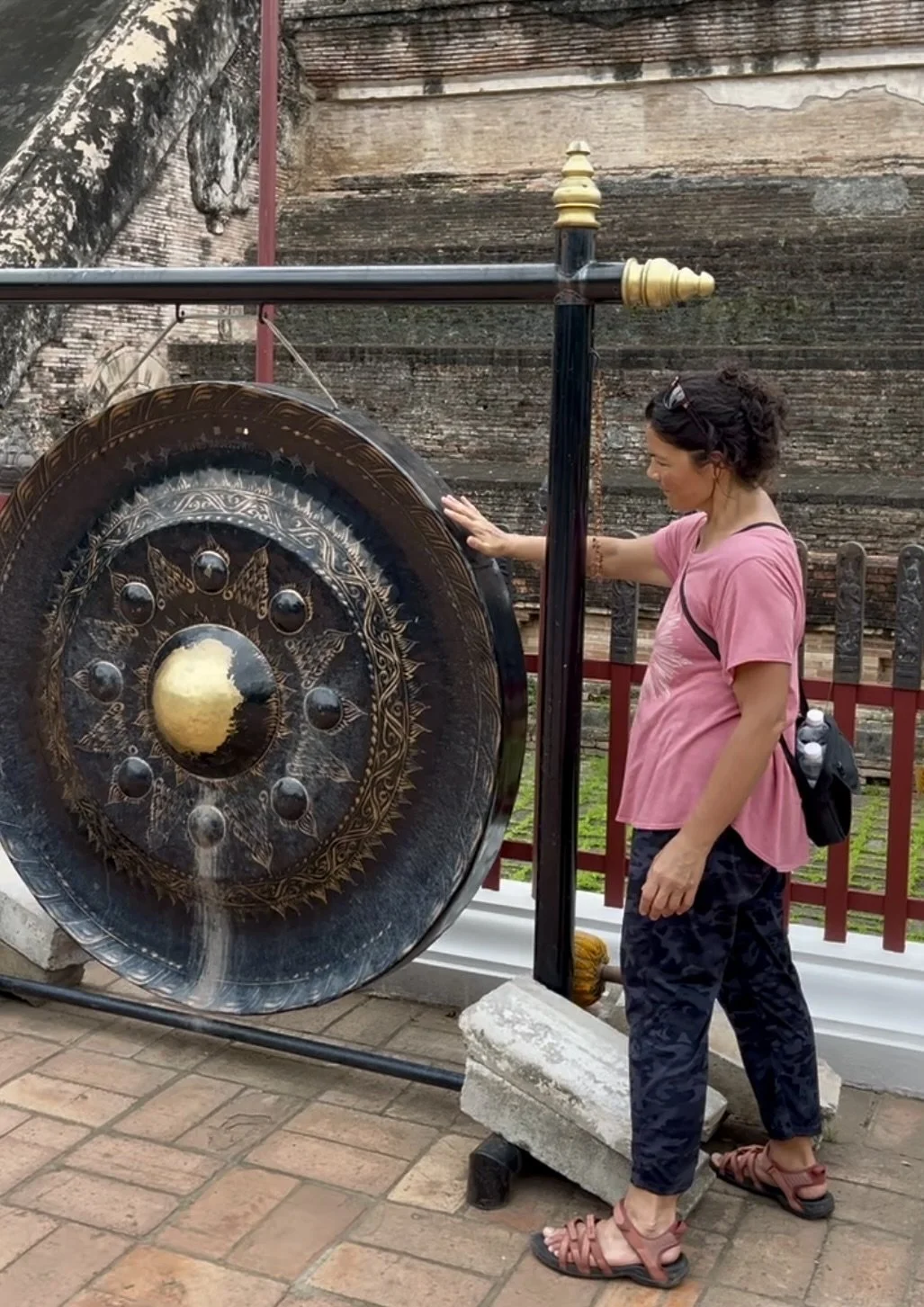
Image: My hand hovers close to a large gong several seconds after it has been struck, I am still able to sense the vibration.
What Is the Benefit?
There are excellent articles available on the ARPF website discussion page that detail the clinical results of their extensive and continued research on Kirtan Kriya, far better than I can in this newsletter. Here is a link to that page. ARPF Discussion Page
Kirtan Kriya meditation immediately resonated with me because it was a body-mind practice. I was not forcing my body to be still as I attempted to ‘control’ my mind. Rather I was engaging both body and mind. Consider the language of building systems: if we only use the mind, it is a ‘top-down’ approach; if we only use the body, it is a ‘bottom up’ approach. Kirtan Kriya mediation works from both directions. It works from the ‘bottom up,’ making use of vocalization, mudras (finger actions), and whole-body posture. It equally works from the ‘top down,’ incorporating specific syllable sounds, visualization, and the meaning of the mantra (the syllables chanted). It involves equal energies moving us toward expanded strength and universal connection.
Expand into Love and Trust
Kirtan Kriya
The mechanics of Kirtan Kriya meditation combine:
Posture, sit comfortably tall.
Chanting the mantra, ‘Saa, Taa, Naa, Maa’
Mudra, finger actions
Visualization, imagining the sounds we are making flowing along a specific pathway.
In this brief video I explain and demonstrate the components and the process of the meditation. Kirtan Kriya Instructions Video
Meaning of the Mantra
The ARPF has studies on the yoga meditation of Kirtan Kriya (in which the practitioner chants the mantra ‘Saa, Taa, Naa, Maa’). I offer a deep bow of gratitude to the APRF for over three decades of sharing research and clinical results to help people of all ages and backgrounds improve their brain function. Dharma Singh Khalsa, ARPF Medical Director, explains that each syllable of the Kirtan Kriya mantra carries meaning
Saa - evokes a sense of expansiveness
Taa - creates a feeling of strength
Naa - stimulates a sense of the universal
Maa - provides the quality of communication
When we understand the meaning of mantras we are chanting, we unite our chitta (mind) to breath-life force and mantra-life force. Rote recitation without knowing the meaning is an exercise. Chanting with the meaning of the mantra is a yoga meditation to unify our minds with the intended directional flow of life force.
I am but a newbie to Kirtan Kriya meditation; my daily practice is just under a year old. Yet, I testify to a sense of ‘expansiveness’ as I have implemented this practice.
Initially I felt as if I was laying down new tracks in ‘unknown terrain.’ With dedicated practice, I feel as if I am deepening pathways to energetic spaces within me—space that I recognize as more spacious rather than constricted. A space where I breathe with ease and sense a growing stability. A space where I feel connected to that which is so much bigger than my individual self. A space where I know I am interrelated with all existence. An inner environment that fosters love and trust.
My Science of Yoga Therapy professor, Dr. Nagarathna Ji, would remind her students and interns regularly that yoga therapists guide the practitioners/patients to cultivate the conditions within themselves to heal. The spaces within me that I recognize as love and trust are these same conditions.
If you’ve ever thought that meditative practices are ‘not for you,’ I invite you to consider the following:
The means for subtle meditative practices are innate to human beings; we come in complete packages, outfitted with body, breath, mind, and spirit.
Feel free to release any assumptions that we are to ‘master’ or ‘control’ the mind; rather allow yourself to witness the movement of your mind and work with what you find.
The invitation is to cultivate the conditions for love and trust within you—the space and grace to grow and heal.
The joy of getting to practice in community (with you) partnered with my ongoing studies of yoga asana, pranayama, and meditation invite and inspire exploration of movement, mantra, sound, and stillness. I invite you to explore the Sounding and Mantra in Motion Collections in the OnDemand library.
September 2026
Chitta
Broadly speaking the Sanskrit word ‘chitta’ translates as ‘mind.’ In the ancient texts of yoga, the term ‘chitta’ encompasses conscious, subconscious, and unconscious parts of the mind. In different contexts ‘chitta’ can refer to thoughts, perceptions, memories, and/or emotions.
In Patanjali’s Yoga Sutras (PYS), the second sutra states,
“Yoga is the cessation of the fluctuations of the mind” (Yoga Chitta Vritti Nirodaha, PYS 1.2).
Our wise ancestors wanted us to know that when you go beyond the chattering surface level of your mind you can submerge into and grow familiar with ‘yoga’—a state of being, a fundamental condition of bliss.
Upon first exposure to this definition of yoga, you might (like me) feel woefully inadequate. Perhaps more so when hearing the commonly used instruction to ‘master’ your mind and ‘stop’ all activity. Gratefully my path of discovery has met with fellow seekers and teachers who have generously shared their experiences and shed light on areas that were once shrouded in mystery. Before you start to skillfully handle your mind, you need to observe the nature of your mind. Often prior to attempting meditation, a wise teacher will guide novices to,
“Observe your mind.”
I recall being surprised by the clamor of my mind upon initially witnessing this observation. I equally recall a sense of relief when I was assured that,
“Your mind will move, observe it moving.”
Your Mind Moves—‘The Default Mode’
Yoga Sutra 1.2, Yoga Chitta Vritti Nirodaha, invites us to recognize that the nature of the mind—‘chitta vritti’ the fluctuations of the mind—is movement of the mind.
Further reading of PYS teaches us that we can begin our yoga journey there. Meeting the mind where it is, in its natural state of motion, and moving with it towards stillness. We can move towards quiet.
The nature of the mind is to move. You may have heard about the ‘default mode network,’ meaning the interaction of various brain regions that comprise the baseline setting for the human mind. If you notice you are daydreaming or wandering down memory lane, that is your default network doing its thing.
The ancient sages were wise to teach us to consider carefully what we choose to yoke our moving mind to.
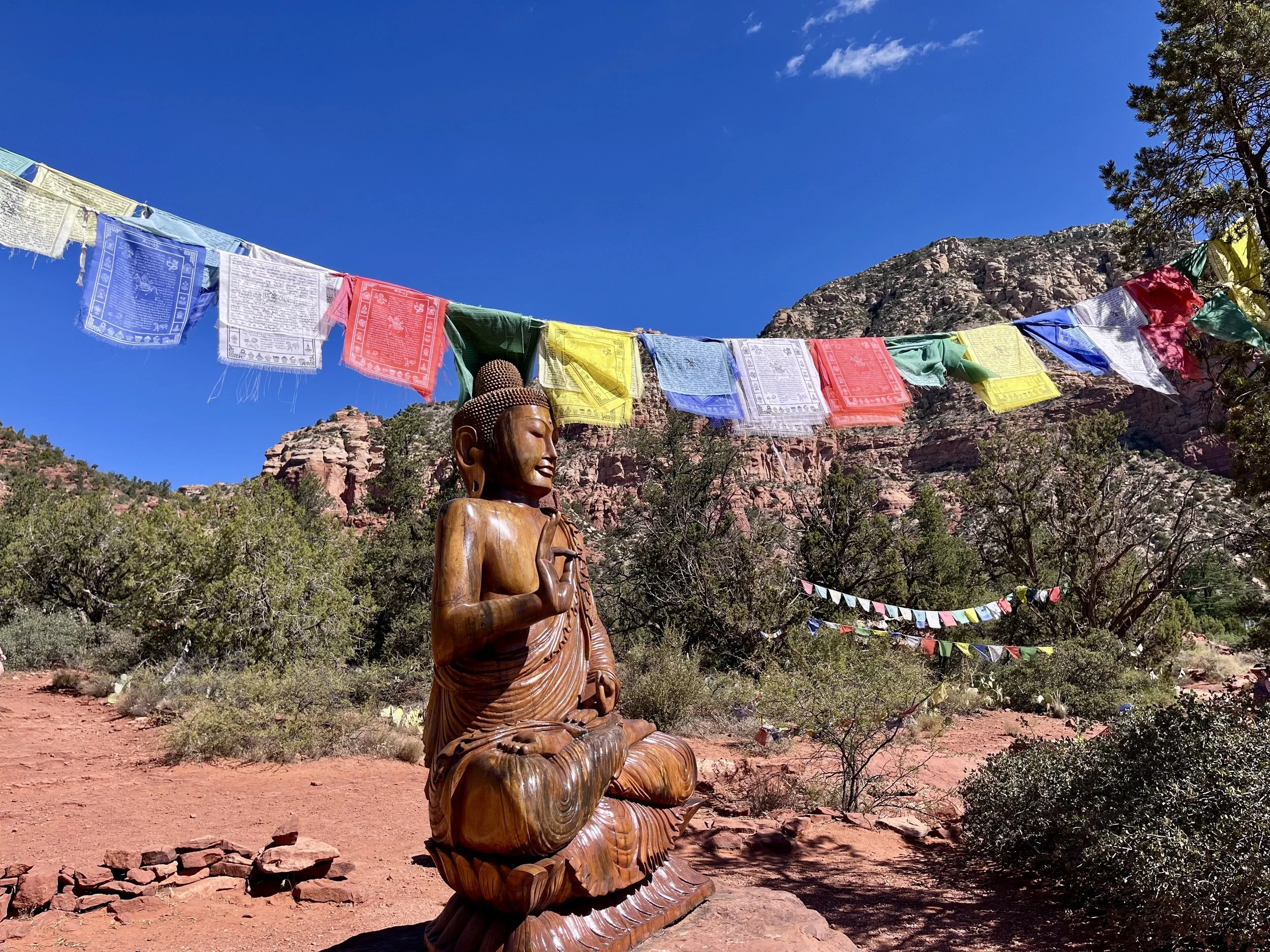
Image: A mahogany statue resides in the Amitabha Stupa and Peace Park located near Sedona Arizona. The gentle breeze flutters the prayer flags and carries the soft sounds of wind chimes and chanting.