
the movement
honor ancestors, serve descendants, nourish all
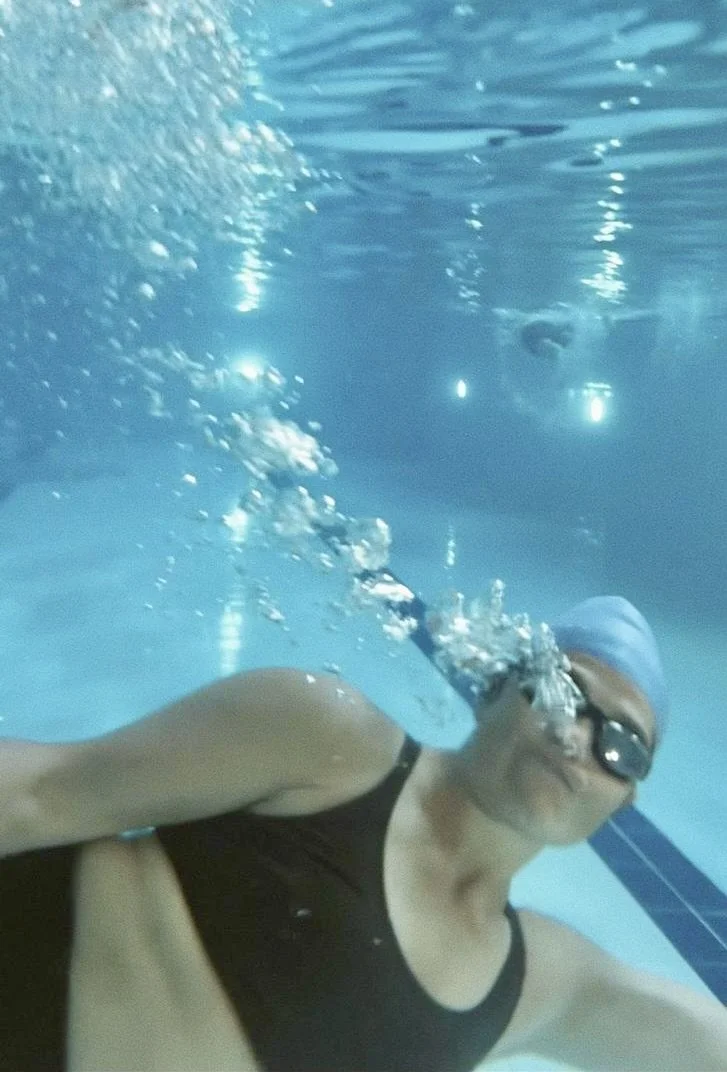
Image: I’m under water, air bubbles are flowing from my nose towards the surface of the swimming pool.
Mantra in Motion
I find myself called to water more frequently these days. The play of buoyancy and splash are always alluring (I see you my aqua aerobics pals!). Recently water has been a refuge. Swimming laps allows a time and space for me to work through the stuff of life that feels tough. I can be big and forceful with my movements, and the water acts as both resistance and support. I swim as vigorously as I can for the initial lengths of the pool, pushing fiercely off the wall and fighting the density of the water. It feels like I’m thrashing out fear and frustration. The good news is I don’t hurt myself or anyone else in the process.
The sound of my breath under the water is usually what signals me that something has shifted. My exhales last longer. The bubbles flow from my nostrils rather than my mouth. My swim strokes lengthen out. The glide phase extends. I rise long enough to inhale and return to the low-frequency-hum of exhaled bubbles under the surface. I attune to the steady rhythm, and a mantra emerges in my mind. As if each out-breath were the accompanying music to the lyric of a heart-song. One long exhale for each line repeated in my mind.
All - is - well
All - is - well
All - will - be - well
I follow the faithful pattern. Breath after breath, the chanting in my mind invites me to simultaneously release angst and animosity, and to embody love and hope.
The use of mantra as medicine is a several thousand years old practice with scientific precision at its roots. I encourage you to dive deep into the yoga of sound and language of Sanskrit. The following is a humble offering of what I am learning through school and life experience. It is but a drop in the vast ocean of sacred sound wisdom.
Why Work at the Subtle Level of our Being?
The previously mentioned ‘doubts’ and ‘dismay’ are thoughts and emotions fluctuating in my mind (a subtle layer of my being). The cascade effect internally is constriction; breath tightens, muscles tense. For my mind to not wreak havoc on my breath and ‘physical body’ layer I want my mind to be familiar with trust and love. So familiar, love and trust become my default setting (so to speak) for my ‘subtle body’ layers.
Without the use of the phrase ‘neuro plasticity’ and ‘behavior change,’ the ancient sages were offering us tools to skillfully handle our mind. The roots of yoga teach us the nature of the mind is to move. Rather than fighting the nature of the mind, we discern what we yoke our mind to. The root word for yoga is ‘yuj’ to yoke, to unite. As in yoke an ox to a cart. As you move through your actives of daily living what direction are you steering your mind?
I want to teach my mind to recognize when it is latched on to an unhealthy cycle of fear and frustration so that I can give it a means by which to release the grasp on what is negative and give it hand to hold that which is positive. Not to spiritually bypass by pretending “I’m fine” as I grit my teeth. Rather to clearly see reality and know my mind has laid down ever deepening tracks of love and trust.
In the ancient text Yoga Sutras of Patanjali (PYS, a guide to embodying yoga), we are offered two immediately available tools and a method for rewiring our mind. The tools are our breath and mantra. The method is detailed in PYS II.33 (chapter two verse 33):
vitarka-bādhane pratipakṣa-bhāvanam
conscious cultivation of the opposite emotion or thought
It is a method of mental reprogramming designed to create the conditions in our mind to default to love and trust.
Mantras carry meaning. The words we speak in our mind matter. We choose words with the energy we want to cultivate.
‘All is well’
Curating energetically where we want to be within ourselves and what we hope to carry into the world around us.
‘Love’
With practice, deepening the tracks we have laid, so no matter what we face, it feels familiar to trust our chosen default mode.
‘Trust’
I remind myself that this is not a “one and done” technique. We nurture our mind by continually coming back to the practice—tending to the conditions we want within.
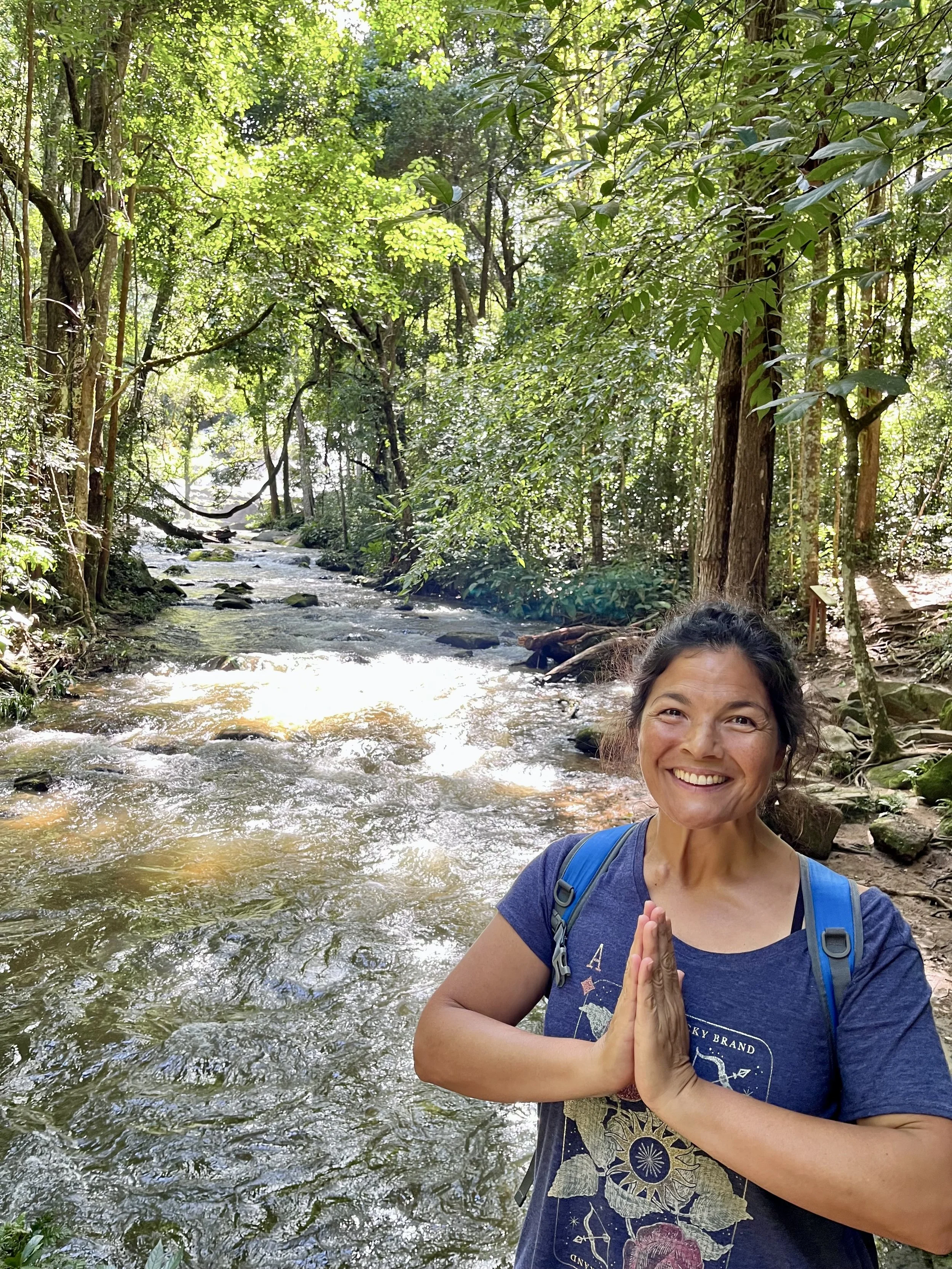
Image: I am standing in a stream in the Doi Inthanon National ParK in Northern Thailand.
Water Gave Me the Word ‘Well’
I have learned my water-born mantra is a variation of the quote by fourteenth-century mystic Julian of Norwich,
‘All will be well, and all will be well, and all manner of things will be well.’
She lived through a time of intense social upheaval and the black plague. Suffering and death were indiscriminate. In that context, how did she have the will to be ‘well’?
Upon further inquiry, I learned Julian of Norwich’s faith guided her to recognize love is at the root of everything, and she invited her fellow humanity to the same. Her words offered radical optimism in the context of her time, and perhaps in our time too. We are invited to know love, and from that knowing, to embody a foundation for actions that transform ourselves and the world around us.
I do not pretend to be as evolved as a mystic. Yet, with hand on heart, I testify to the potent power of mantra and the restoration my water-born-heart-song brings. I climb out of the pool steady in spirit. Heart and mind open to embrace whatever comes.
What are the words in your mind?
What condition do you want to cultivate within you?
The roots of yoga remind us: we have what it takes, body, breath, and mind.
May you be well.
August 2026

Image: Hubby and pals on their scuba advanced open water dive training, 2025, in the waters of Bonaire. Each diver has a steam of air bubbles flowing from their regulators.
How Mantra Works
The Sanskrit word ‘mantra’ is a compound of ‘mana’, meaning mind, and the suffix ‘tra’ from the root ‘tr’ meaning to protect. ‘Tra’ is common to the words ‘vaditra’ meaning instrument, ‘yantra’ meaning tool, and ‘vaktra’ referring to your mouth or face.
The concept of mantra as a mind tool helps me conceive the use of mantra to cultivate my mind. You may have heard or experienced the repetition of ‘Om’ in a yoga class or meditation hall. Meditative, rhythmic repetition of a mantra (aloud, whispered, or mentally) is a yogic practice called ‘japa.’ Maintaining awareness on repeating ‘Om’ guides your mind away from daily distractions. As you turn your awareness inward you reconnect with deeper states of being. Ironically, a sounding practice connects us with a state often described as inner quietude, silence, peace and rest. A growing field of research shows sincere and consistent mantra practice can help humans combat the physiological effects of stress. A regular practice can lower cortisol levels (less strain on your internal systems) and release endorphins (mood boost, yes please!)
Mantra and Japa
Mantra and japa become a means to carry you from the density/opacity of the ‘physical body’ to the more ‘subtle body’ of your mind and wisdom.
Mantra is a sacred sound, syllable, word, or phrase. Japa, the repetitive chanting of a mantra, is used to focus the mind and deepen spiritual awareness.
Aloud japa. Audible chanting with a relaxed vocal quality.
Whispered japa. Soft muttering, barely audible to others.
Silent japa. Purely mental, the silent repetition is considered the most potent form of the practice.
As the vibration penetrates all the layers of our being, the repetition becomes ‘ajapa-japa,’ meaning the mantra is resonating within you, but there is no effort or thought on your part. As if you have been absorbed into the sound, or the frequency is flowing through you.
The concept of mantra as a mind instrument helps me understand how the application of a mantra affects all aspects of my being. The word ‘instrument’ makes me think of musical instruments. For me the mention of music immediately conjures harmony. Mantra as an instrument brings our whole being in resonance (rather than dissonance) with ourselves, each other, and all of existence. The roots of yoga teach us we are pancha kosha (five sheaths): body-breath-mind-wisdom-spirit. Chanting specific mantras (like ‘Om’) attunes our pancha kosha vibration to harmonize with the cosmos.

Image: When it is too cold to get in water I sit by a body of water and simply breathe. This sweet spot is along the Potomac River in Old Town Alexandria in VA, late winter 2023.